Field service
Multi-van field service, facilities and utility management
Several vans or crews, a diary that changes by the hour, and an office permanently one step behind the work.
Every job drags an enquiry, a quote, a schedule, an invoice and a chase behind it, and every one of those is a place where the day leaks.
01://WORK
The work has its own vocabulary.
And the system speaks it.
Reactive jobs against planned maintenance, response times you have committed to, the engineer who is nearest versus the one who is qualified, parts that need ordering before Tuesday, certificates that have to exist before the invoice can go out, and subcontractors whose paperwork arrives late or not at all.
02://DOES
The job, from the first call to the money landing.
So the system holds the job from the first call to the money landing. It takes the enquiry, prices it off your rules, puts it with the right crew, tells the customer when they are coming, collects what the engineer did, raises the invoice off that, and chases it. Nobody retypes the same address into a fourth screen.
- Job from enquiry to paid, in one thread
- Diary that survives a reshuffle at 07:40
- Certificates and job records attached where the invoice needs them
- The chase that happens on day 14 whether or not anyone remembers
03://SYSTEM
One system. Not six logins.
A facilities team usually runs a CAFM, an accounts package, a spreadsheet, a WhatsApp group and a separate compliance tool, none of them talking to each other. We bring them into one, and everyone gets the view that fits their job.

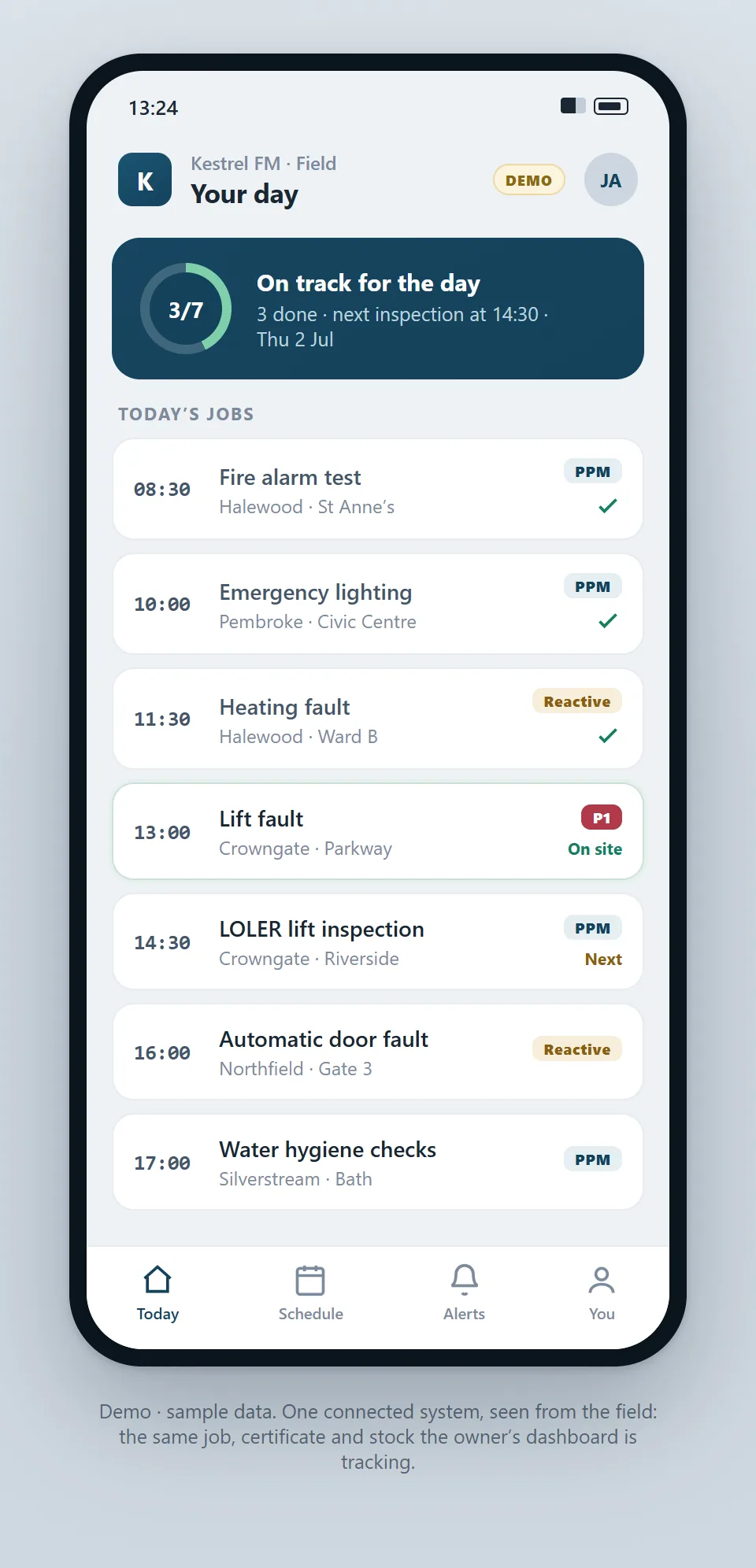

Raise it once, it is everywhere. A client's request becomes a job on the engineer's phone and a line on your board. The certificate they upload on site clears the invoice. The parts they use drop the van stock and reorder themselves. One thread, three views.
Reactive work costs several times what the same job costs planned: emergency callouts, out-of-hours rates, parts bought in a hurry. UK maintenance standards are built planned-first for exactly that reason, and so is this system.SFG20, the UK standard for building maintenance, published by BESA with BSRIA, CIBSE and IWFM.
04://VIEW
One place where the whole picture sits.
What is live right now, what is waiting on someone, what has been invoiced, and what has not been paid. It is the view you currently assemble by asking three people. You do not run the system from it, you see it from it, and you can hand that view to whoever needs it.
It wears your name, not ours.
Every name and number below is sample data, at the size of an operation running several depots. The shape does not change with the number of vans.


05://FIT
Are we any use to you?
Here is the honest answer before you spend an hour finding out.
We can almost certainly help
- Fifty vehicles or more, or several depots, and a diary that gets rebuilt during the day
- A back office of several people who are all still a step behind the work
- Response times you have committed to in a contract, and the paperwork that has to exist before the invoice can go out
- Quoting, scheduling, invoicing and chasing spread across more than one system, and no single place where the whole picture sits
We can probably help
- Ten to fifty vehicles, growing, with one or two people holding all of it together
- One depot today, but the second one is already on the table
- Subcontractors whose paperwork arrives late, or not at all
- You have systems already and the problem is that none of them talk to each other
We are probably not the best fit
- A handful of vans, one diary, one person. You do not have a relay problem yet, and we would be solving one you do not have
- The admin is a few hours a week and it is under control. Keep your money
- You want a website, an ad campaign or a one-off script. That is somebody else's job and they will do it better
- You want to hand over the whole thing and never look at it. This works because you still own the rules
If you are in the middle box and not sure, ask us. We will tell you which one you are actually in, including when the answer is the third one.
Tell us what your week looks like.
We will tell you honestly whether we are any use to you.